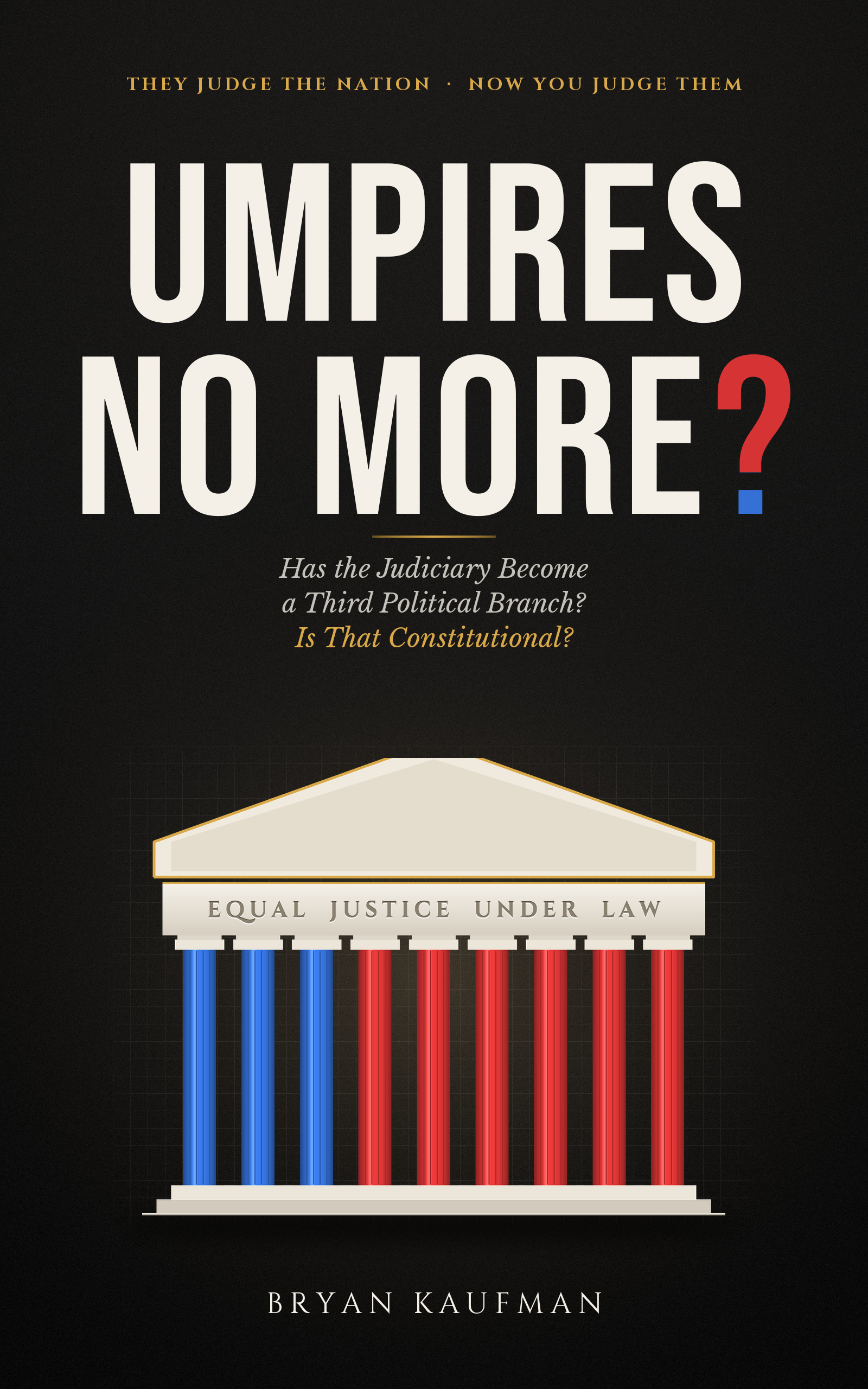
THEY JUDGE THE NATION · NOW YOU JUDGE THEM
UMPIRES
NO MORE?
Has the Judiciary Become a Third Political Branch?
Is That Constitutional?
In 2005, John Roberts promised the Senate a judge is just an umpire, calling balls and strikes. Twenty-one years later, the Court strikes down tariffs, saves birthright citizenship, and lets a president fire an independent agency, all in one term. Which is the real Court? This book hands you the evidence and the gavel.
GAME 1 · PROMISE VS. VOTE
They told the Senate. Then they voted.
Each card shows what a justice told the Senate. Tap to flip it and see what happened next. Kept, broken, or somewhere in between? You decide.
GAME 2 · MYTH OR FACT
How well do you know the Court?
Score: {{ mythScore }}
{{ m.claim }}
{{ m.verdict }}
{{ m.why }}
YOUR TURN ON THE BENCH
Which justice are you?
Decide landmark cases from Marbury v. Madison in 1803 to birthright citizenship in 2026. Each one gives you the background, the words that mattered, and the best case for each side. After every ruling, see what the Court actually did.
At the end you’ll learn how often you sided with the Court, which of today’s nine justices you vote like, and which justice in history is your judicial twin.
Skip any case you’d rather not decide.
{{ cur.caseName }}
{{ cur.q }}
{{ cur.ctx }}
{{ cur.words }}
{{ cur.result }}
{{ youLine }}
{{ cur.note }}
YOUR JUDICIAL TWIN IN HISTORY
{{ histTop.name }}
You agreed on {{ histTop.m }} of the {{ histTop.n }} cases {{ histTop.pronoun }} decided: {{ histTop.cases }}.
ON TODAY’S COURT, YOU VOTE LIKE
{{ curTop.name }}
Agreed on {{ curTop.m }} of {{ curTop.n }} shared cases.
Blue: nominated by a Democratic president. Red: by a Republican president.
HOW YOU’D RULE
{{ courtM }} of {{ courtN }}
times you reached the same result as the Court. Your next-closest justices in history:
{{ h.name }}: {{ h.m }} of {{ h.n }}
YOUR RULINGS VS. THE COURT
SHARE YOUR VERDICT
{{ shareText }}
Tip: screenshot the dark result card above to post it as an image.
Matches use only the cases each justice actually decided, so a justice with more shared cases is a sturdier match. Want the reasoning behind every vote? It’s all in the book.
GAME 3 · GUESS THE VOTE
Nine justices. How did they split?
Most people guess wrong. Score: {{ guessScore }}
{{ g.year }}
{{ g.q }}
{{ g.verdict }}
{{ g.why }}
MEET THE NINE
Collect the whole bench
{{ cardsIntro }}
THE PARTY TEST
One blueprint. Three prints.
The framers drew one blueprint for an independent Court. The book takes ten recent cases where the two parties lined up on opposite sides and asks who formed the majority.
The six Republican appointees formed the majority on their own.
Three Democratic appointees can’t make a majority alone.
Mixed majorities, with justices from both sides joining forces.
EXPLORE THE TEN CASES
{{ ptSel.name }}
Bar color shows the nominating president’s party. “Broke ranks” means the justice voted against that party’s side.
So is it politics in robes, or law with a pattern? The book makes the case for both, then lets you decide.
WHAT’S INSIDE
No law degree required
The Court in 60 seconds
A plain-English primer on how cases get there, how justices decide, and how to read a ruling like a pro.
Words vs. votes
Twelve chapters line up what the justices told the Senate with how they later voted.
The 2025–26 term
Tariffs, the Fed, birthright citizenship: the blockbusters, who joined whom, and why it matters.
You be the justice
Decide eight real cases with the best argument for each side, then compare your votes to the Court’s.
Check yourself
Two quick questions end every chapter, with answers in the back, so the ideas stick.
Both sides, at full strength
Every charge comes with the defense’s best answer. You’re the judge, not the jury of one party.
223 YEARS IN 14 RULINGS
The Court that changed America
Scroll sideways through the rulings that shaped the country.
THIS TERM AT THE COURT
What the Court just did
Updated Oct. 15, 2026.
FCC v. Brown
The Court granted the FCC’s stay, keeping discounted ad rates for party committees through the midterms. Justices Sotomayor and Jackson objected.
Suncor Energy v. Boulder County
The new term opened with climate-change suits against energy companies. Justice Alito sat out the case.
People Not Politicians v. Onder
Missouri’s 2022 congressional map will govern the midterms, with no noted dissent.
Slaughter, Cook, Barbara, B.P.J.
Four blockbusters in two days: a president can fire an FTC commissioner, but not a Fed governor without notice; birthright citizenship holds; states may limit girls’ teams.
STRANGE BUT TRUE
When states sue states, they skip the line
A few fights start at the Supreme Court itself. Some of them are wonderfully odd.
Who owns Ellis Island?
New York kept the original 3 acres. New Jersey got the landfill added later, which is most of the island today. New Jersey v. New York (1998).
The great MoneyGram fight
Delaware collected a fortune in uncashed money orders bought all over the country. A unanimous Court said that money generally belongs to the states where they were bought. Delaware v. Pennsylvania (2023).
Smoke across the state line
Georgia sued to stop sulfur fumes from Tennessee copper smelters, and won the right to an injunction, in one of the nation’s first environmental cases. Georgia v. Tennessee Copper Co.
BOOK CLUBS AND CLASSROOMS
Argue about it. Respectfully.
The built-in Talk It Over guide gives your group ten discussion questions and three activities, from a mock confirmation hearing to a vote on your own Party Test. It works for a living-room book club, a civics class, or a law-school seminar.
A QUESTION FROM THE GUIDE
Should a justice who said a precedent was “settled” be held to that word years later? What would change your mind?
EVERY FACT, SOURCED
Don’t take our word for it
Every quotation, citation, vote count, and date was checked against court opinions, Senate records, and the original reporting. The full Cite-Check Report shows the work.
LEGAL TERMS DECODER
Court-speak, translated
{{ termCount }}
{{ tm.t }}
{{ tm.d }}
READ A RULING WITH ME
A real opinion, decoded
Every Supreme Court opinion opens the same way. Here are the key lines from Loper Bright Enterprises v. Raimondo (2024), the case that ended Chevron deference. Tap any line to see what it tells you.
FOR TEACHERS
Ready-to-teach lesson plans
A one-period plan and a three-day unit built on this site’s quiz, games, and Party Test, aligned to the C3 Framework civics standards, with printable student handouts. Grades 9–12 and college.
FREE DOWNLOADS
Try it before you buy it
EARLY READERS
“[EARLY READER QUOTE]”
[READER NAME, CREDENTIAL]
STAY IN THE LOOP
New rulings explained in plain English, the day they come down. No spam, no politics-by-email.
QUESTIONS, ANSWERED
Before you take the bench
Is this book liberal or conservative?
Neither. Every charge in the book comes with the defense’s best answer, mixed majorities get full credit, and the final verdict is yours. The color rule is simple: blue marks Democratic appointees, red marks Republican appointees, and purple marks majorities that mixed both.
Do I need to know anything about law?
No. A plain-English primer explains how the Court works, how cases get there, and how to read a ruling. Two quick questions at the end of every chapter help it stick.
Where do the facts come from?
Court opinions, Senate hearing records, official statistics, and the original news reporting. Every quotation, citation, vote count, and date was checked against those sources, and the Cite-Check Report shows the work.
How does the quiz pick my justice?
It compares your answers with each justice’s actual votes, using only the cases that justice decided. A justice who shares more cases with you counts as a sturdier match, so one lucky overlap can’t win.
Was AI involved?
Yes. The book was written with Claude, an AI assistant made by Anthropic. The author conceived the book and its argument, directed the research, and reviewed and revised numerous drafts, and every source was checked.
NINE JUSTICES · ONE VERDICT · YOURS
Now you be the judge.
Paperback and ebook. Plain English, full color, and every fact checked.